Deepening Your Thai Massage – Step 2
19 januari 2026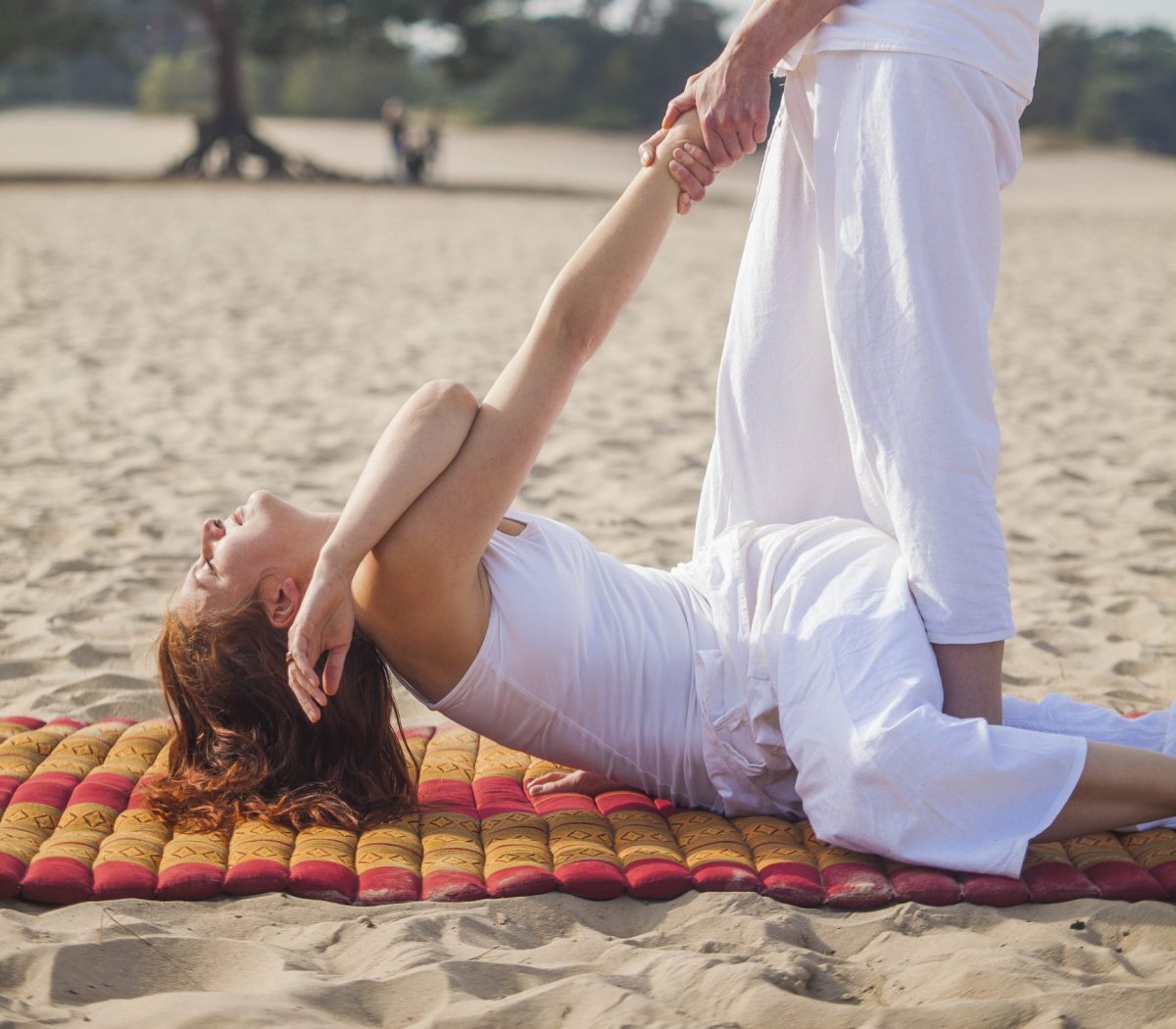
Bridging Muscles, Nerves and Motion
Deepening Your Thai Massage – An East–West Approach to Thai Bodywork is a book by Tirza Bottema, founder of Thai Dee and teacher of Thai massage for more than three decades.
It invites practitioners to deepen their touch by weaving Eastern healing traditions together with Western insights into movement, anatomy and the nervous system.
Organised into three pillars — Body, Mind and Energy — nine steps form a practical and poetic roadmap for embodied therapeutic work.
This blog offers a first glimpse into Step 3: Bridging Muscles, Nerves and Motion.
The Two Sides of the Body Are Always Talking
Although we often think of the body as two halves, they constantly cooperate.
When one leg steps forward, the opposite arm swings. When one side bears weight, the other helps stabilise. Signals cross the centre of the body all the time, coordinating balance and timing.
Thai massage naturally works with this principle. Rocking, twists and diagonal stretches stimulate this cross-body communication — reminding the system that movement belongs to the whole, not to one side alone.
Muscles Work in Teams
It is tempting to think that pain or stiffness comes from a single tight muscle. In reality, muscles always act in groups. When one area becomes restricted, neighbouring regions adapt — often forming chains of tension.
Some create the movement.
Others lengthen to allow it.
Still others stabilise joints and posture.
They function like a team.
For Thai massage therapists this is crucial. If one spot feels blocked, treating only that location is seldom enough. By widening your focus the body often releases more deeply and sustainably than with a purely local approach.
Spirals, Diagonals and Natural Motion
Human movement is rarely straight. We twist, rotate and shift weight in spirals and diagonals.
Thai massage reflects this natural geometry. Instead of linear stretches, it often circles joints, spirals limbs, and gently winds through the torso. These movements invite multiple muscle groups to reorganise together, while also engaging cross-links in the nervous system in a calm, coordinated way.
Step 3 encourages you to sense these patterns not as theory, but as living pathways beneath your hands.
A Practical Translation to Your Practice
In your next session, try this:
when you meet strong tension — for example around a hip or shoulder — widen your field. Explore neighbouring areas, follow the tension across the joint, and notice what happens when you masage the opposite side or add slow rocking or rotations. Work both sides, diagonally, move in gentle spirals, and pause long enough for the system to reorganise.
Ask yourself:
Where does the movement travel?
What happens when I massage on the other side?
What softens first?
Often the deepest shift appears not exactly where discomfort was felt — but where the body rediscovers cooperation.
Why This Deepens Your Thai Massage
Step 3 belongs to the Body pillar of Deepening Your Thai Massage, alongside herbs and fascia. It lays the groundwork for intelligent movement, refined touch and a listening therapeutic presence.
✨ Let your Thai massage become less about fixing isolated parts,
and more about restoring conversation within the whole body.
Curious to explore more?
You can find the book at Deepening your Thai massage – an East-West approach to Thai Bodywork through major online bookstores worldwide.
In the Netherlands you can buy the book at Bol.com, while international readers can also find the book via platforms such as Amazon.